Moonshot AI released Kimi K3 on July 16, 2026 — the first open 3T-class model ever published — and it's already wired into Napsix's AI Gateway.
Why it matters
Kimi K3 is a 2.8 trillion-parameter model (Mixture-of-Experts, activating 16 of 896 experts per token) built on two proprietary architectural innovations — Kimi Delta Attention (KDA) and Attention Residuals (AttnRes) — which, together with a refined training recipe, deliver roughly a 2.5× improvement in scaling efficiency over the previous generation (Kimi K2). It marks the latest step in Kimi's sustained push at the scaling frontier: for 9 of the past 12 months, Kimi models have set the upper bound of open-model sizes.
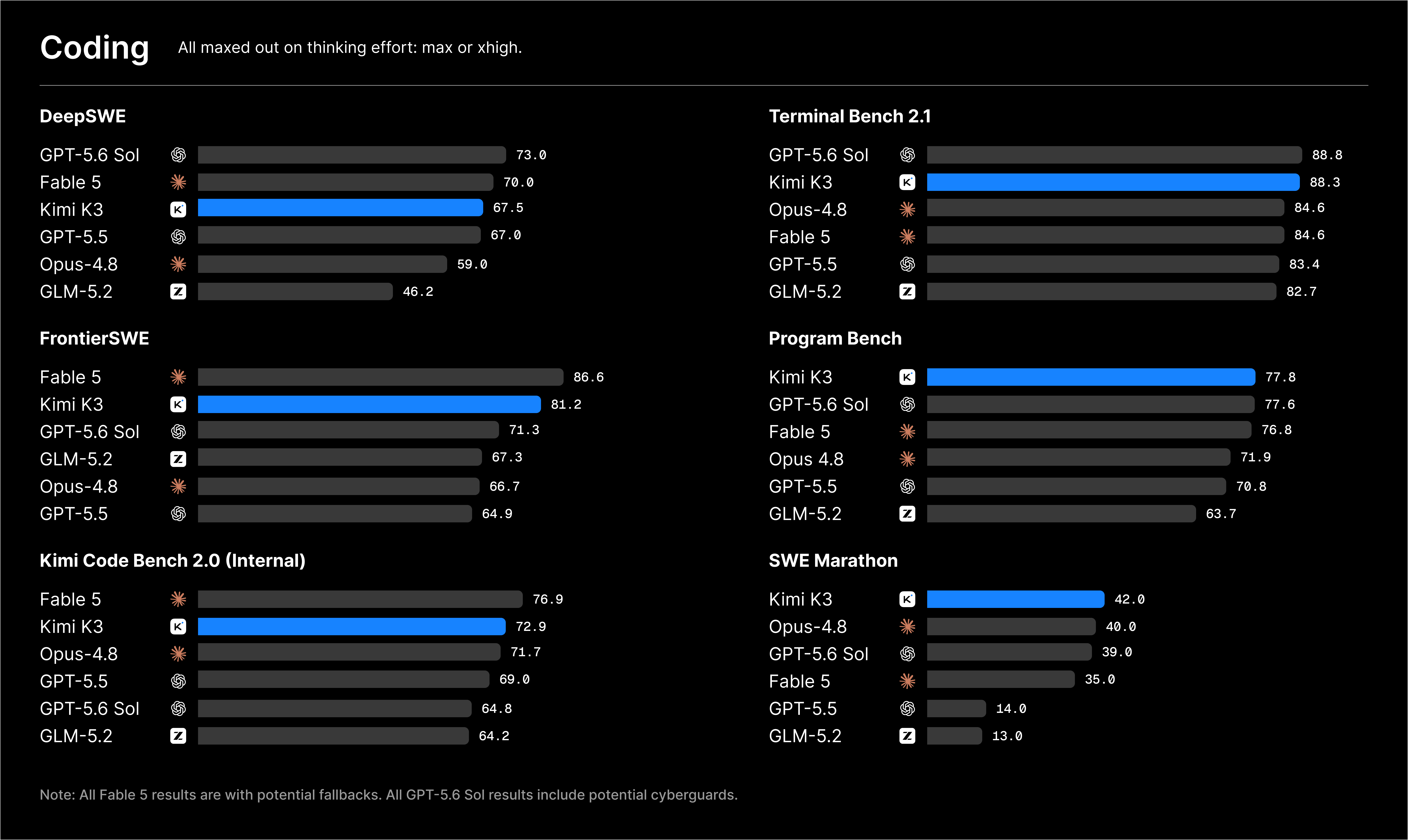
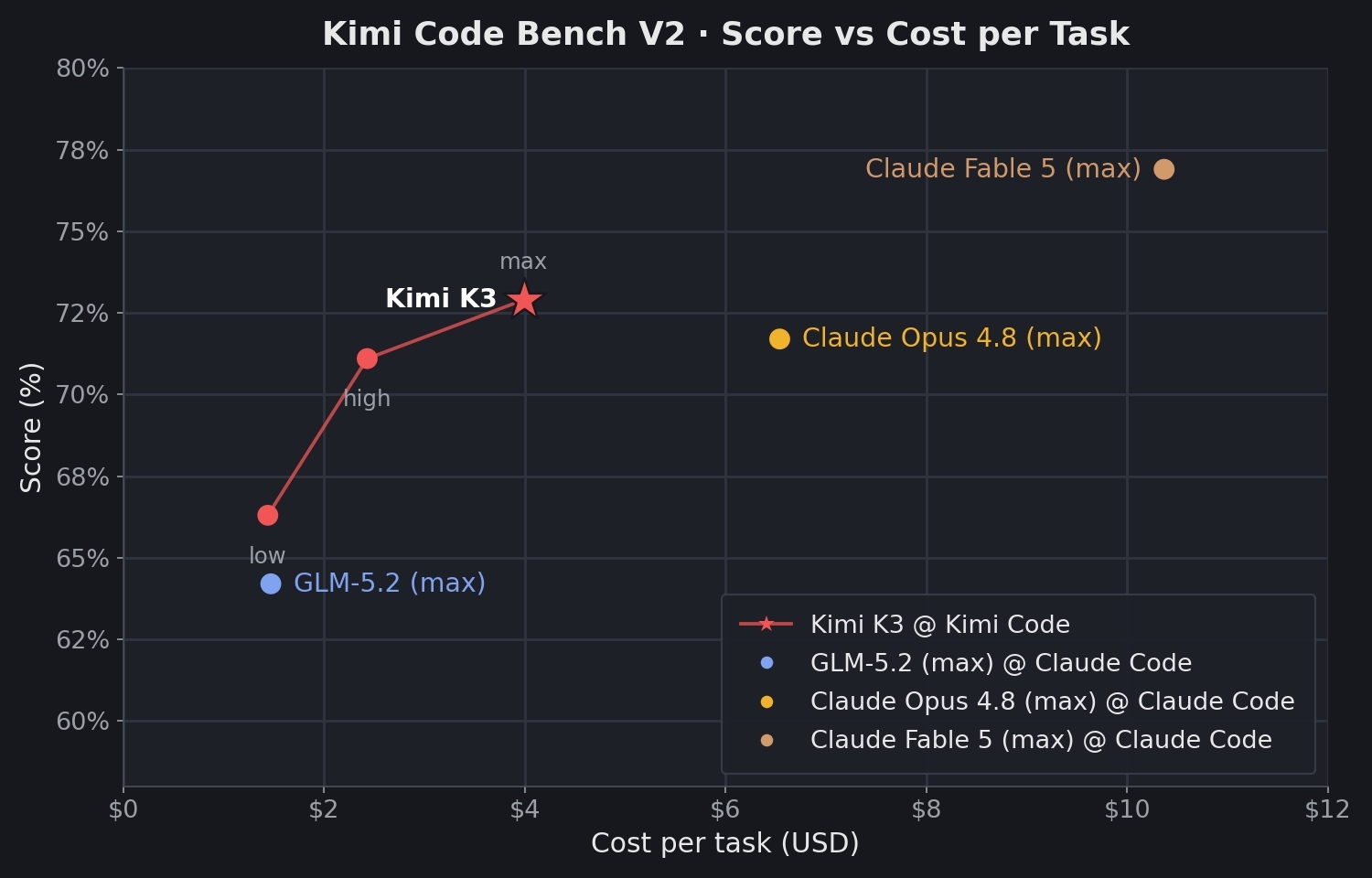
While it still trails the strongest proprietary models (Claude Fable 5 and GPT-5.6 Sol), Kimi K3 demonstrated frontier-level performance across most of the evaluation suite, consistently outperforming every other tested model — and it's first among open models on Artificial Analysis's intelligence index, in addition to topping the Arena.ai leaderboard for frontend web development (1679 Elo, first in 6 of 7 frontend domains).
Real use cases that stood out
Moonshot documented several case studies showing just how far K3's long-horizon agentic capability goes:
- GPU kernel optimization: given an identical sandbox with up to 24 hours to profile, rewrite, and benchmark 4 tasks (AttnRes, KDA, and a 512-head-dimension MLA kernel) across NVIDIA Hopper GPUs and an alternative GPGPU, K3 performed competitively with Fable 5 (with fallback) and substantially outperformed Opus 4.8, GPT 5.6 Sol, and GPT 5.5.
- GPU compiler development from scratch: K3 built MiniTriton, a compact Triton-like compiler with its own tile-level IR layer over MLIR, optimization passes, and a PTX code-generation pipeline. Across supported roofline benchmarks, MiniTriton delivers performance on par with or better than Triton and torch.compile — beating Triton on certain workloads — and sustains stable end-to-end nanoGPT training.
- Chip design: as an early proof of concept, K3 designed a chip to serve a nano model built on its own architecture. In a single autonomous 48-hour run, it built, optimized, and verified the chip using open-source EDA tools (the Nangate 45nm library). Within just 4 mm², the chip closes timing at 100 MHz and sustains over 8,700 tokens/s decode throughput in simulation, packing 1.46 million standard cells, 0.277 MB of SRAM, and an INT4 MAC array with fused dequantization.
- Coding for research: K3 completed in about two hours what would typically take one to two weeks of work by an experienced researcher — reproducing the I-Love-Q universal relations in computational astrophysics: it reviewed and cross-validated 20+ papers, implemented the full numerical pipeline, evaluated 300+ equations of state, identified inconsistencies in published formulas, generated 3,000+ lines of Python code, and produced an interactive HTML dashboard.
- Video editing: in a striking example, K3 edited its own teaser video from 56 source clips, handling clip selection, motion-matched cuts, frame-accurate beat synchronization, audio processing, and multiple rounds of revision — a high-density short video like this would typically take an experienced editor 1-2 working days, or a beginner 3-5.
Architecture
K3 combines Stable LatentMoE (activating 16 of 896 experts) with Quantile Balancing (deriving expert allocation directly from router-score quantiles, eliminating heuristic updates and a sensitive balancing hyperparameter) and Per-Head Muon (optimizing attention heads independently). Sigmoid Tanh Unit (SiTU) and Gated MLA improve activation control and attention selectivity respectively. Training applies MXFP4 (weights) + MXFP8 (activations) quantization from the fine-tuning stage onward, and Moonshot contributed a KDA prefill-cache implementation to the vLLM community, released alongside the model.
Pricing and availability
$0.30 per million cache-hit input tokens, $3.00 per million cache-miss input tokens, and $15.00 per million output tokens — powered by Mooncake's disaggregated inference architecture, which achieves a cache hit rate above 90% in coding workloads.
Available today on Kimi.com, Kimi Work, Kimi Code, and the Kimi API (Kimi Platform). Full model weights land July 27, 2026 — making it the largest open-weight model ever published. Moonshot shared the official launch video on X.
⚠️ Limitations Moonshot documents itself: K3 is sensitive to thinking history (use a harness with verified compatibility, like Kimi Code) and may show excessive proactiveness on ambiguous, long-horizon tasks — impose explicit behavioral constraints in the system prompt if your application needs well-defined boundaries.
On Napsix
Kimi K3 is already active in Napsix's model catalog (served via OpenRouter, with a direct Moonshot key as a cheaper future path). Pick it from the model selector in any XIA chat for long-horizon coding, knowledge work, or deep reasoning tasks.
