Context
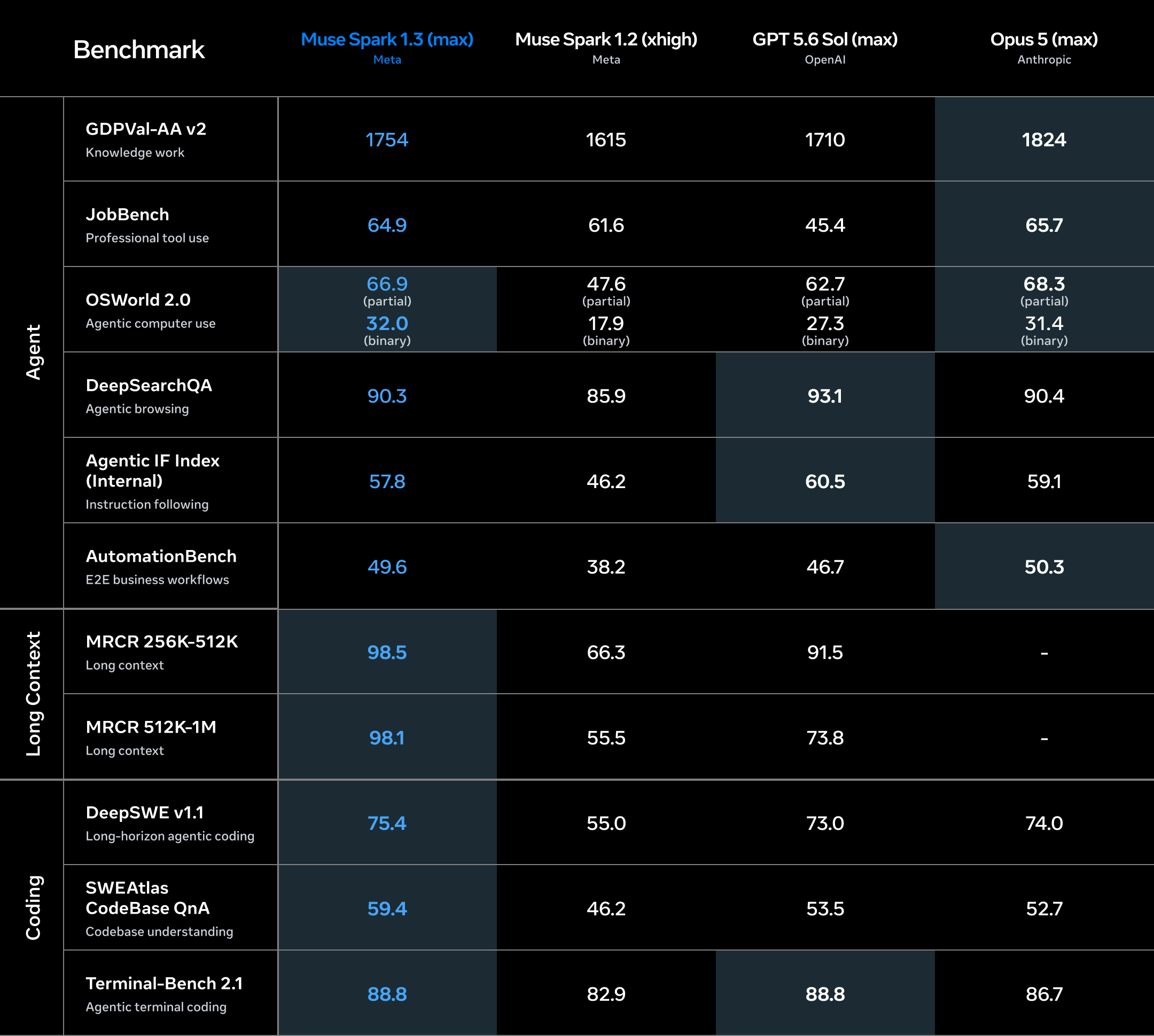
Meta introduced Muse Spark 1.3, an update to its Muse Spark model focused on long-horizon agentic work and coding tasks. According to Meta, the model improves on its predecessor Muse Spark 1.2 and is benchmarked against GPT 5.6 Sol (max) and Opus 5 (max) across agent, coding, instruction-following, and long-context evaluations.
What's changing
Per Meta's release, Muse Spark 1.3 brings:
- Sustained agentic work: keeps context across long threads, proactively corrects gaps in its own plan, and collaborates with users (asks clarifying questions, confirms before consequential actions).
- More accurate multitasking: maps incoming prompts to the right task even within messy, single-threaded conversations.
- Better self-awareness: has a clearer sense of what it can and can't do, instead of hallucinating outcomes.
- More efficient coding: per Meta's internal comparisons, it uses ~20% fewer tool calls and ~25% fewer tokens than 1.2, with a cleaner overall coding style.
What this means for you
NapsixB2B is a multi-agent, multi-user, multi-model agentic OS built on efficiency over brute force: every task gets routed to the right-sized model rather than forcing everything down one path. New releases like Muse Spark 1.3 expand the pool of options in that routing layer, particularly for long-running agentic workflows and for coding tasks where token and tool-call efficiency translates directly into cost and speed.
What we're doing
We're evaluating Muse Spark 1.3 alongside Claude, GPT, Gemini, and Bedrock within our model pool, to bring it in wherever its performance profile adds real value for our clients' agents — while keeping a free-tier of models always active. We'll share updates once it's live in specific workflows.
